
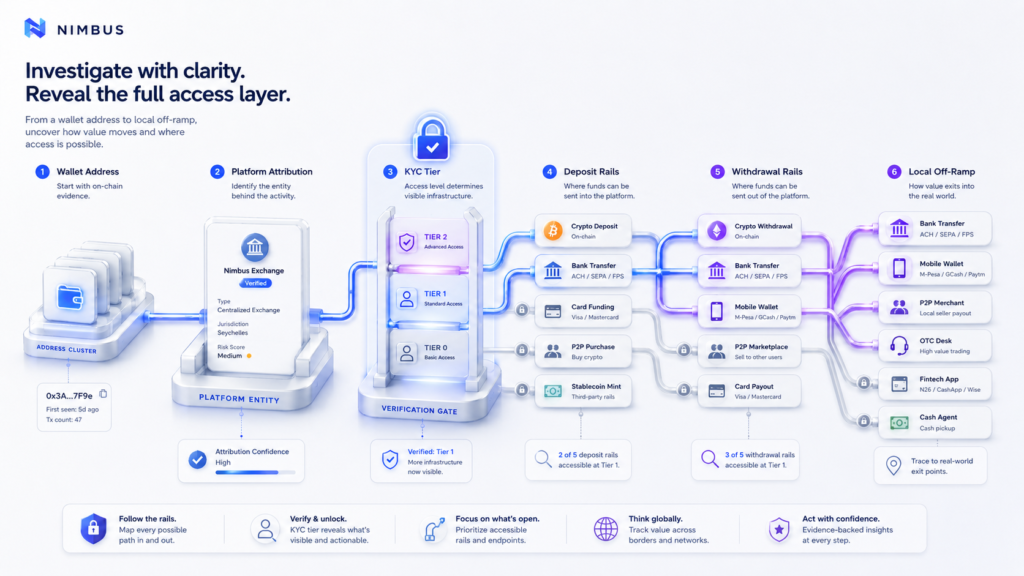
Most crypto investigations focus on addresses, clusters, entities, and transaction flows. That is the natural starting point. The blockchain is visible. The graph can be queried. Funds can be traced across wallets, bridges, mixers, exchanges, and contracts.
But when funds touch a centralised service, the investigation enters a different environment.
At that point, the question is no longer only:
Which address belongs to which platform?
It becomes:
What level of access does the user have inside that platform?
This is where KYC tiers matter.
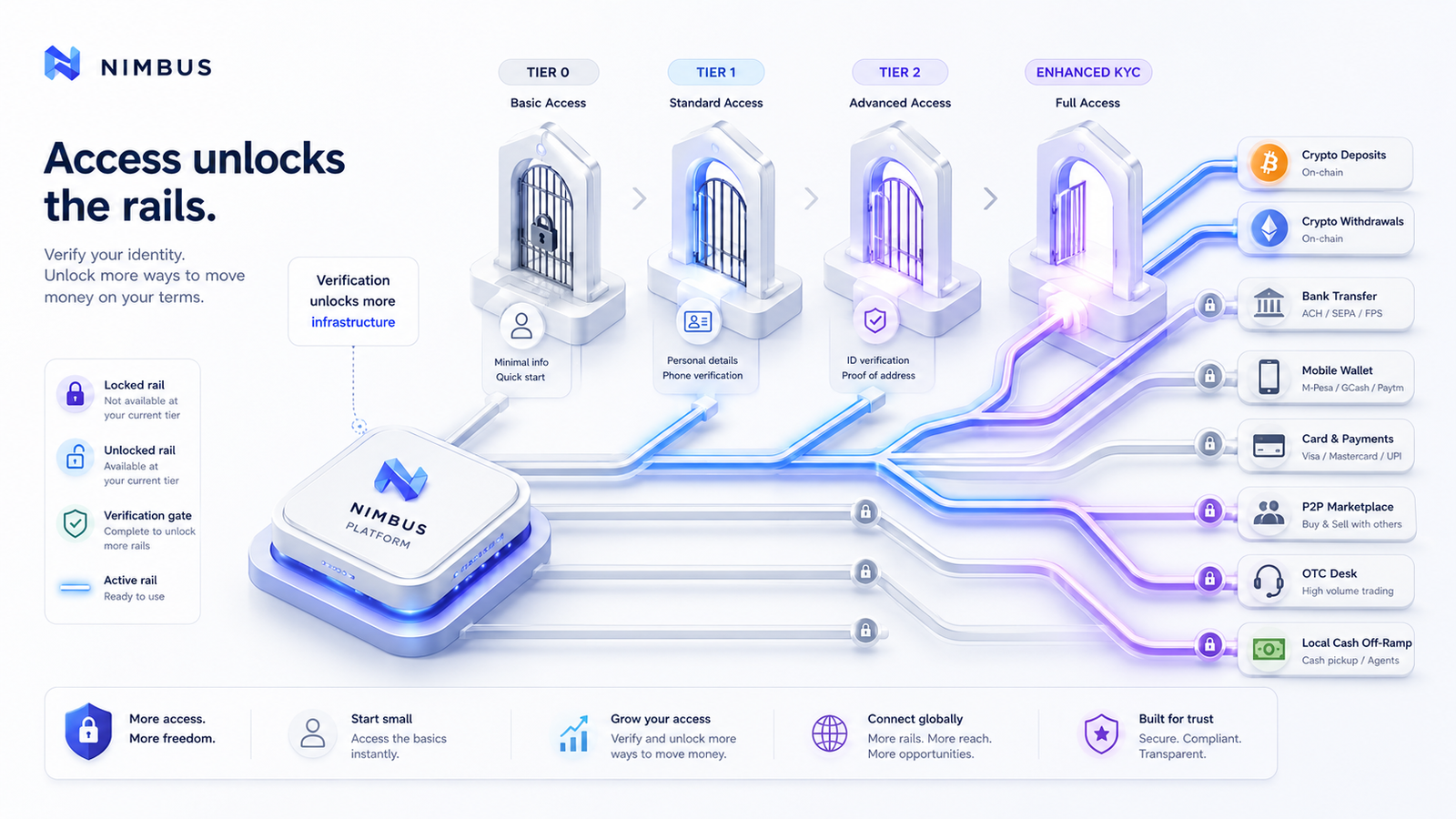
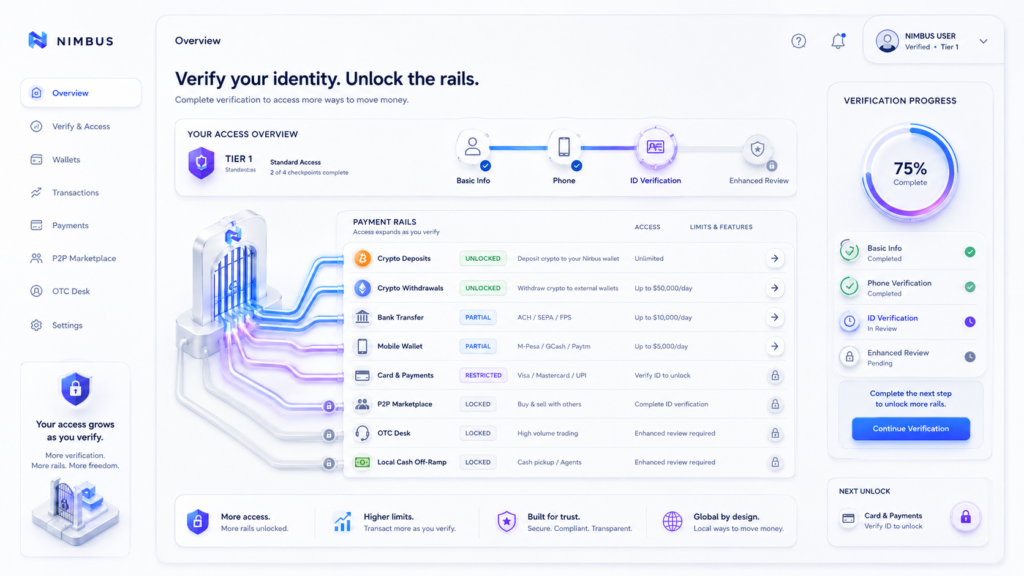
A basic account may see one set of deposit rails. A verified account may see another. A locally verified account may unlock domestic payment methods. A higher-tier account may enable larger withdrawals, additional chains, OTC features, fiat transfers, or business services.
In some markets, the difference between Tier 0 and Tier 2 is the difference between a platform being practically useless and being a real cash-out route.
For investigators, attribution teams, and compliance vendors, KYC tiers are not just a compliance detail.
They define the observable surface of the venue.
“Does this platform require KYC?” is too shallow.
The better question is:
What changes at each KYC level?
Many crypto platforms use tiered access. Lower tiers may allow browsing, wallet creation, or limited deposits. Higher tiers may unlock:
That means two researchers testing the same platform can reach different conclusions depending on account status.
For example:
All three may be correct within their own access tier.
This is why investigations that ignore KYC tiers produce weak venue intelligence.
FATF expects virtual asset service providers to apply preventive measures similar to financial institutions, including customer due diligence, record-keeping, suspicious transaction reporting, and Travel Rule information handling. But in practice, platforms implement those obligations through layered product access.
The compliance layer becomes an infrastructure layer.
For attribution work, that infrastructure layer determines what can be tested.
A false negative happens when an investigator concludes that a rail, chain, or withdrawal path does not exist because it was not visible at their access level.
This is common.
A platform may hide certain features until the user completes identity checks. For example:
If the researcher stops at the first layer, the platform is under-mapped.
That creates bad intelligence.
The dataset may say:
When the real answer is:
It may say:
When the real answer is:
It may say:
When the real answer is:
This matters because criminals, brokers, P2P merchants, and high-volume users are unlikely to operate only at the lowest tier. They will use whatever tier gives them functional liquidity.
A low-tier test tells you what a casual user sees.
It does not always tell you what the platform can do.
The most important investigative features often appear only after deeper verification.
These can include:
From an intelligence perspective, this changes the map.
A venue that looks minor from the outside may become significant after higher-tier access reveals local fiat payout, stablecoin liquidity, or P2P merchant activity.
A platform that appears crypto-only may quietly support local bank transfer after KYC.
A broker-style app may show no meaningful functionality until local identity is approved.
This is especially important in emerging markets, where local cash-out paths often depend on:
A global researcher with a foreign account may see one platform.
A local verified user may see the real platform.
Wallet attribution is stronger when it is backed by live platform behaviour.
A weak attribution record says:
“Address appears connected to Platform X.”
A stronger record says:
“Verified account generated this deposit address for USDT-TRC20 on this date. Deposit was credited. Withdrawal was available after Tier 2 KYC. Screenshot and TXID attached.”
The second record is materially more useful.
KYC tier context gives the address meaning. It shows:
Without KYC-tier metadata, attribution can become ambiguous.
Important questions remain unanswered:
These details matter during investigations.
They also matter when a dataset is used by someone who did not perform the original test.
Crypto platforms often use the word “supported” loosely.
A platform may technically support an asset, chain, or payment method, but only under specific conditions.
For example:
This is why support claims need to be tested under specific account conditions.
For investigations, the phrase “Platform X supports USDT” is not enough.
The useful version is:
“Platform X supports USDT deposits on TRON and Ethereum for verified users in Country Y. Withdrawals are available after Tier 2. Fiat cash-out to local bank appears after domestic identity verification. Tested on [date].”
That is the difference between marketing information and intelligence information.
Some platforms behave differently depending on user geography.
A Thai user, Indian user, Nigerian user, Brazilian user, Turkish user, or UAE user may see different payment rails, currencies, documents, transaction limits, and withdrawal options.
A foreign resident may see another version again.
This can happen because of:
This matters because off-ramp mapping is local by nature.
The same exchange may offer one set of features globally and a different set in a specific country. A global dataset may correctly identify the exchange but still miss the local cash-out mechanics.
For investigators, the local version is usually the one that matters.
If funds are being cashed out in a specific market, the question is not only whether the platform exists.
The question is:
What can a verified local user actually do there?
Crypto apps often show features that are not fully usable.
A deposit button may exist, but no address may generate.
A withdrawal screen may exist, but the route may fail.
A fiat method may appear in the app, but require additional documents.
A P2P market may load, but trading may be unavailable until verification.
A local bank rail may show in the interface but reject foreign users.
This creates interface noise.
For attribution work, the goal is not to screenshot every visible option. The goal is to determine which options work under which conditions.
A clean verification record should separate:
This structure prevents shallow conclusions.
It also makes the dataset more useful for teams that need to understand whether a venue is merely listed or actually operational.
Good intelligence should be reproducible.
If one analyst says a platform supports a rail, another analyst should be able to understand how that conclusion was reached.
That requires more than a screenshot.
A useful verification record should include:
This protects the dataset from becoming a black box.
It also helps downstream teams decide whether they trust the record, need to retest it, or should treat it as historical evidence only.
KYC level can also change how a transaction should be interpreted.
A transfer into an exchange account with no withdrawal rights may mean something different from a transfer into a fully verified account with high fiat limits.
A deposit into a platform that only allows trading after identity checks is different from a deposit into a platform where unverified users can move funds freely.
A withdrawal from a high-tier account may suggest deeper account preparation, identity access, or broker-level usage.
This does not automatically prove suspicious activity. But it adds useful context.
For example:
KYC tier is not just a compliance label.
It is a behavioural context layer.
KYC rules are not fixed.
Platforms change verification requirements when:
A platform that allowed withdrawals at Tier 1 last year may require Tier 2 today.
A local bank withdrawal method that once required only basic identity may now require proof of address.
A P2P feature that was previously open may now require facial verification.
A chain that was visible before KYC may now be hidden until account approval.
This is another reason static datasets decay.
A record should not only say what was tested. It should say when it was tested and at what KYC level.
Without that, old access assumptions can survive long after the platform has changed.
Basic attribution asks:
Which wallet belongs to which venue?
Access intelligence asks:
What can a user actually do inside that venue, at which verification level, in which country, and through which rails?
The second model is much stronger.
It connects wallet attribution with operational reality.
A proper access intelligence record should capture:
This turns a wallet label into a usable intelligence object.
KYC tiers matter because they define the difference between visible infrastructure and usable infrastructure.
A platform may look inactive from the outside but become a real off-ramp after local verification.
A rail may appear unsupported at Tier 0 but work at Tier 2.
A withdrawal path may look broken until proof of address is approved.
A local bank route may be invisible to foreign researchers but available to domestic users.
A deposit address may only become meaningful once the account context is known.
For crypto investigations, this affects:
The blockchain can show where funds moved.
KYC-tier intelligence helps explain what was possible once those funds reached a service.
The real question is not only:
Which venue does this wallet belong to?
It is:
What could a verified user do there?
That is why KYC tiers matter