
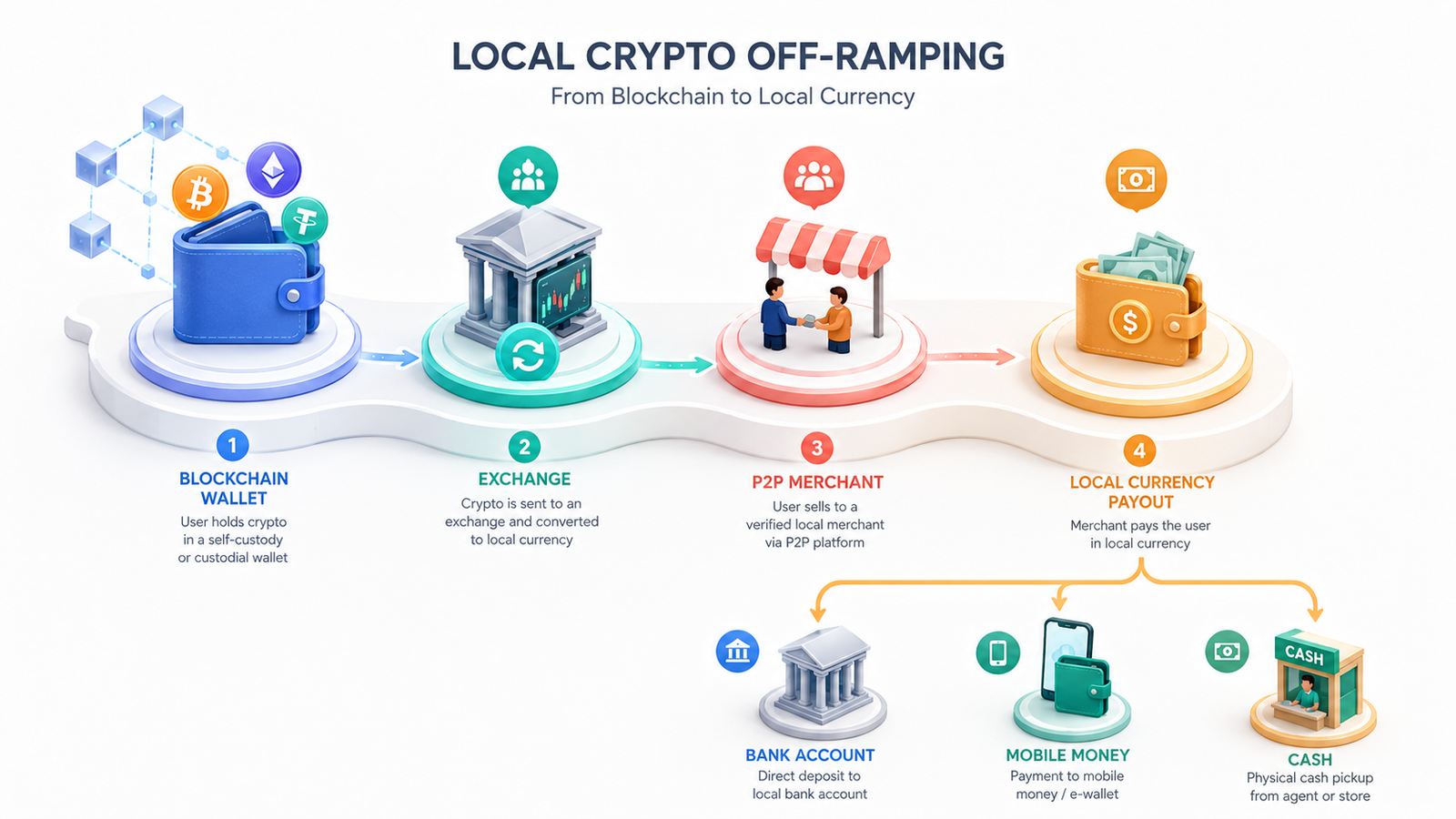
Crypto does not become useful when it is bought. It becomes useful when it can move back into the local economy.
Most blockchain attribution work starts with exchanges. That makes sense. Centralised exchanges are visible, high-volume, and easier to categorise than the fragmented networks around them. They have deposit addresses, withdrawal flows, compliance teams, public domains, app interfaces, and often a formal relationship with regulators.
But in many markets, exchanges are only the cleanest part of the picture.
Real-world cash-out behaviour often moves through a wider off-ramp ecosystem: local brokers, P2P merchants, fintech apps, mobile money, OTC desks, remittance shops, payment processors, gambling platforms, tokenised investment apps, informal Telegram liquidity groups, and region-specific wallet services.
If you only map exchanges, you map the obvious layer.
If you want to understand how crypto actually leaves the chain and enters local economies, you need to map the local off-ramp layer.
A centralised exchange can convert crypto into fiat, but it is not always the route people use.
In emerging markets, users often care less about whether a platform is globally recognised and more about whether it solves the final-mile problem:
Mastercard’s explanation of crypto on-ramps and off-ramps defines an off-ramp as the process of moving crypto or stablecoins into fiat-denominated goods, services, cards, or bank accounts. That definition matters because off-ramping is not limited to exchange order books. It includes the wider conversion layer between crypto balances and real-world spending power.
For attribution teams, the risk is simple: if the map only includes exchanges, it may miss the actual exit route.
A formal exchange is easy to name. A functional off-ramp is harder.
A local off-ramp may be:
Some of these entities are licensed. Some are semi-formal. Some are simply operationally important because users trust them, liquidity exists there, and money actually moves.
This is the difference between regulatory taxonomy and intelligence taxonomy.
Regulators may classify entities as VASPs, payment providers, brokers, money service businesses, gambling operators, fintechs, or unlicensed actors. Investigators need a second question: does this entity provide a practical crypto-to-fiat path in this market?
That is the off-ramp question.
P2P cash-out is often described as a product feature inside exchanges. That framing is too narrow.
In practice, P2P behaves like distributed local liquidity infrastructure. A user sells crypto to another user, receives local currency through a bank transfer, mobile money, wallet app, or other domestic payment method, and the crypto stays inside the platform or moves to the merchant’s wallet.
Recent primers on off-ramping describe P2P services as a way for users to sell crypto directly to another person in exchange for fiat, often using local payment apps and currencies. They also note that the model is less regulated and can be exploited by bad actors.
For blockchain intelligence, this creates a problem.
The on-chain movement may only show a deposit into a platform, merchant wallet, or intermediary address. The fiat leg happens off-chain, inside domestic payment rails. Unless the off-ramp actor is identified, the transaction graph stops too early.
This is why local P2P merchant mapping matters.
It can reveal which merchants are active, which payment methods they support, which currencies they serve, which venues they use, and whether they act as repeat liquidity points.
Bitcoin used to dominate many illicit and grey-market crypto flows. That is no longer the whole story.
Chainalysis’ 2025 crypto crime reporting notes that some categories, such as ransomware and darknet markets, remain Bitcoin-heavy, while other activity, including scams and laundering, increasingly spreads across a broader set of asset types.
Stablecoins changed the local off-ramp problem because they are easier to price, easier to quote, and often better suited for cross-border and emerging-market use cases. A local broker can quote USDT to naira, pesos, reais, rupees, lira, baht, dong, dirhams, or rand without needing users to manage Bitcoin volatility.
Fintech infrastructure providers also increasingly describe stablecoin off-ramps as a way to convert stablecoins into local currency and withdraw to bank accounts or mobile money.
That means the relevant off-ramp map is not only “which exchanges support BTC withdrawals?”
It is also:
Stablecoin liquidity has made the local layer more important, not less.
A narrow VASP list is useful, but incomplete.
FATF’s updated recommendations continue to focus on anti-money laundering and counter-terrorist financing standards for virtual assets and virtual asset service providers. But the practical cash-out ecosystem in many countries includes actors that do not always look like cleanly registered crypto exchanges.
For intelligence and compliance use cases, the map should include several layers.
Licensed exchanges
These are the obvious entities: regulated local exchanges, approved brokers, and compliant trading platforms.
Globally accessible exchanges
These may not be locally licensed but can still serve users in the country through cards, P2P markets, crypto deposits, or local payment methods.
P2P markets and merchants
These are often critical in countries where banking access is fragmented, capital controls exist, or users prefer stablecoin liquidity over exchange order books.
Fintech and payment apps
Some apps integrate crypto directly. Others touch crypto indirectly through partners, payment processors, or stablecoin infrastructure.
OTC brokers and local liquidity desks
These matter for higher-volume flows, business users, remittance corridors, and informal settlement.
Gambling, gaming, and high-risk payment rails
These can act as practical conversion points, especially when deposits and withdrawals bridge crypto and fiat.
Remittance and cash agents
In some corridors, crypto is not the user-facing product. It is the settlement layer behind local payout.
This broader map is less tidy than an exchange list. It is also more useful.

A weak off-ramp map asks: who accepts crypto?
A stronger off-ramp map asks:
This is where desk research fails.
A website may claim to support crypto. The app may show a deposit button. The interface may list USDT. But after account creation, the picture can change. KYC may block access. The deposit address may not generate. Withdrawals may be disabled. Local bank transfer may be available only after higher verification. Some rails may appear in the interface but fail during execution.
Off-ramp mapping needs live testing, not only public data.
A common mistake is ignoring deposit-only platforms because they do not support crypto withdrawals.
That is too simplistic.
A deposit-only platform can still be important if crypto enters the service and value exits through fiat, vouchers, betting balances, merchant payments, local bank transfer, prepaid cards, or app credits.
From a blockchain perspective, these platforms may look like sinks. Funds go in and do not come back out on-chain. But from an investigative perspective, that may be exactly why they matter.
The question is not only whether crypto can be withdrawn.
The question is whether crypto can be converted into local value.
A platform that accepts USDT and pays out in local currency may be more relevant to cash-out mapping than a small exchange with on-chain withdrawal support but no meaningful local liquidity.
Global datasets tend to overrepresent visible global exchanges and underrepresent local actors.
That creates blind spots in countries where users rely on regional apps, small brokers, P2P merchants, remittance rails, and fintech workarounds.
The blind spot is not only about missing names. It affects transaction interpretation.
Without local off-ramp context, an analyst may see a transfer to an unfamiliar address and classify it as unknown. But locally, that address may belong to a popular broker, a P2P merchant, a remittance-facing platform, or a deposit processor used by multiple apps.
This is especially important in markets with:
In these markets, the local map is not optional. It is the core intelligence layer.
A good off-ramp record should not just say “Platform X is active in Country Y.”
It should capture evidence.
At minimum:
The strongest datasets separate public claims from tested access.
That distinction prevents overconfidence.
“Website says USDT supported” is not the same as “local verified account generated a TRC20 deposit address on 7 May 2026, deposit confirmed, balance credited, withdrawal to local bank option visible after KYC.”
The second record is intelligence. The first is a lead.
Exchange-first mapping starts with a list of known venues and asks where they operate.
Country-first mapping starts with a market and asks how crypto actually converts into local value there.
That shift changes the investigation.
In a country-first model, the analyst does not only ask, “Which exchanges are licensed here?”
They ask:
This approach is messier. It also matches reality.
A local off-ramp map is not a neat compliance directory. It is a working model of how value exits crypto in a specific country.
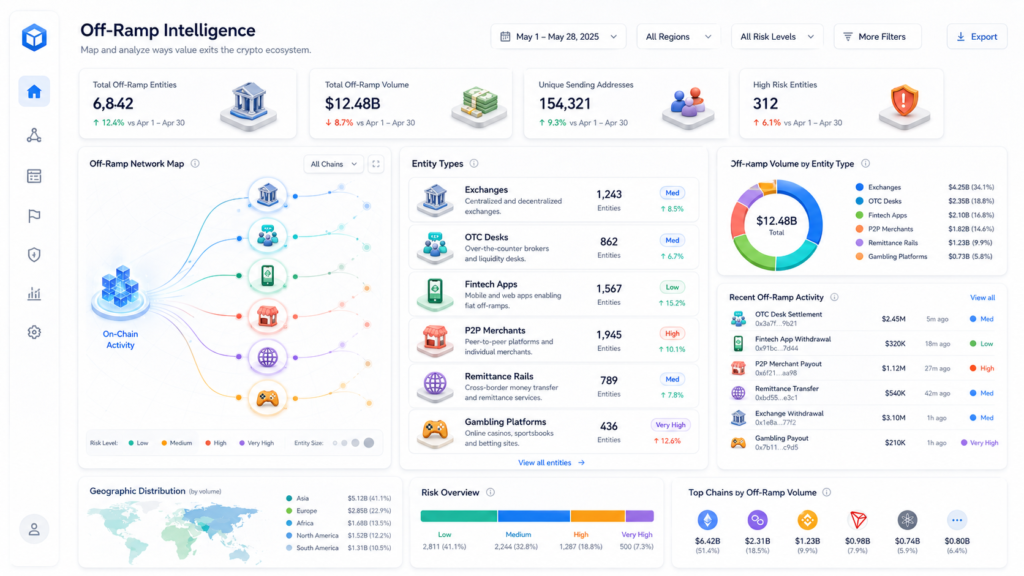
For compliance teams, local off-ramp mapping improves alert triage, entity enrichment, and exposure analysis.
For investigators, it helps identify where funds may have exited into fiat.
For Travel Rule and VASP discovery teams, it reveals entities that may not appear in standard global registries.
For blockchain analytics vendors, it improves coverage in markets where global exchange lists are too shallow.
For law enforcement and threat intelligence teams, it helps convert on-chain leads into local investigative leads.
The value is not just better labels. It is better operational context.
A wallet address attached to a known global exchange tells one story. A wallet address tied to a local broker, P2P merchant, or deposit-only fintech route tells another.
Blockchain intelligence often begins with on-chain clustering. But the economic meaning of a flow depends on what happens at the edge of the chain.
That edge is local.
A user in Lagos, Bangkok, São Paulo, Istanbul, Ho Chi Minh City, Dubai, Nairobi, Manila, or Buenos Aires may not cash out through the same route shown in a global exchange directory. They may use a local merchant, a P2P desk, an app, a payment processor, a regional broker, or a venue that is invisible to most global datasets.
That is why off-ramp mapping needs to go beyond exchanges.
The real question is not only:
Which exchanges operate in this country?
It is:
How does crypto become usable local money here?
That is the map that matters.