

Crypto infrastructure looks clean from the outside.
Exchange directories show company names. Apps show supported assets. Websites mention deposits, withdrawals, fiat rails, payment options, and regional availability.
But for intelligence, compliance, and attribution teams, that surface layer is not enough.
The real questions are operational:
Nimbus Labs conducted a multi-country crypto platform discovery and verification study across Brazil, Nigeria, and Thailand to answer these questions.
The goal was to map the real platform landscape in each market, classify the different types of crypto access points, and verify selected platforms through live account access, wallet capture, and transaction-level evidence.
Crypto markets in Brazil, Nigeria, and Thailand are not built around one simple platform type.
Each market contains a mix of:
For external analysts, these ecosystems are difficult to map accurately.
Public research can show that a platform exists. It cannot always show whether the platform is accessible, whether wallets are active, whether deposits are credited, whether withdrawals work, or whether users are pushed into fiat cashout instead of on-chain exits.
That creates a blind spot for teams working on:
Nimbus’ task was to move beyond directory-level research and create a structured, evidence-backed view of how these markets actually function.
The study had three primary objectives.
First, identify the active crypto platforms operating in Brazil, Nigeria, and Thailand.
Second, classify those platforms by type, function, and relevance to crypto access.
Third, verify selected platforms through account-level review, wallet capture, deposits, withdrawals, screenshots, transaction records, and structured evidence notes where feasible.
The project was designed to answer:
The study covered three markets with different crypto adoption patterns and local infrastructure dynamics.
Brazil has a more formalised crypto ecosystem, with local exchanges, investment platforms, payment-linked services, and regulated market participants.
The study reviewed Brazil-facing platforms across categories such as:
A sample verification was completed for Mercado Bitcoin, one of Brazil’s major local exchanges.
Nigeria has a highly active crypto market shaped by P2P demand, local payment constraints, remittance needs, stablecoin usage, and mobile-first user behaviour.
The study reviewed Nigeria-facing platforms across categories such as:
A sample verification was completed for Prestmit, showing how crypto wallet access and transaction evidence can be captured in a local Nigerian platform context.
Thailand has a more regulated local exchange environment, but also includes global platforms, broker-style services, digital asset platforms, wallets, and alternative crypto access points.
The study reviewed Thailand-facing platforms across categories such as:
For Thailand, the focus was platform landscape mapping and categorisation rather than a single highlighted transaction example.
Nimbus used a structured discovery and verification workflow across all three markets.
Nimbus identified relevant platforms through local market research, platform directories, app availability, user access checks, ecosystem references, and crypto payment/off-ramp mapping.
Platforms were not treated as equal.
Each one was classified based on its actual role in the market.
Categories included:
This helped separate true trading venues from payment tools, broker interfaces, passive investment apps, and crypto-adjacent platforms.
Where feasible, Nimbus reviewed whether users in the relevant market could access each platform.
This included checking:
This step is important because a platform can appear relevant in public search results but be inaccessible, restricted, inactive, or functionally irrelevant to local users.
Each platform was mapped by function, not just name.
The classification considered:
This gave clients a clearer view of the actual market structure.
For selected platforms, Nimbus captured wallet-level evidence.
This included:
Wallet capture helps establish whether a platform exposes real crypto rails to users.
Where feasible, Nimbus conducted micro-transactions to verify live platform functionality.
Testing included:
This is the difference between saying “the platform appears to support USDT” and proving “USDT was deposited, credited, withdrawn, and confirmed on-chain.”
Findings were organised into structured deliverables.
These included:
The output was designed for analyst use, not marketing fluff.
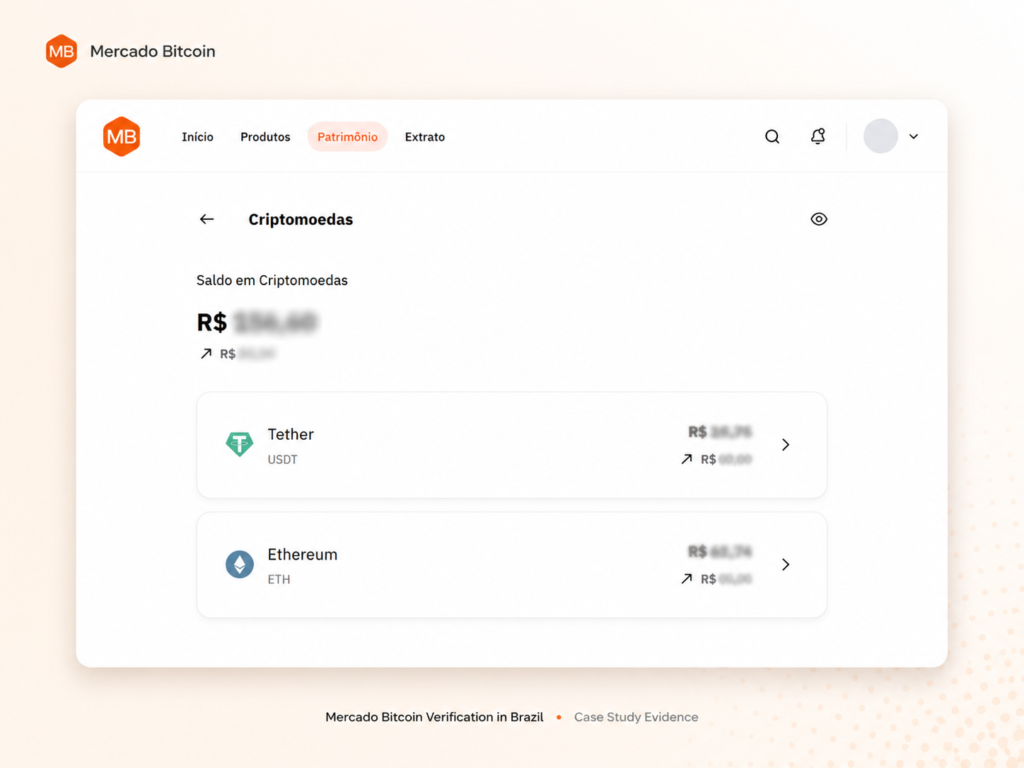
Mercado Bitcoin was used as a Brazil verification sample.
The objective was to test whether a major local Brazilian exchange could be verified through live wallet access and transaction-level evidence.
Nimbus verified:
This created a two-way verification path:
For attribution workflows, this is high-value evidence.
It does not simply show that Mercado Bitcoin exists. It shows that specific user-facing crypto rails were functional, transaction-tested, and verifiable on-chain.
That turns a platform entry into operational intelligence.
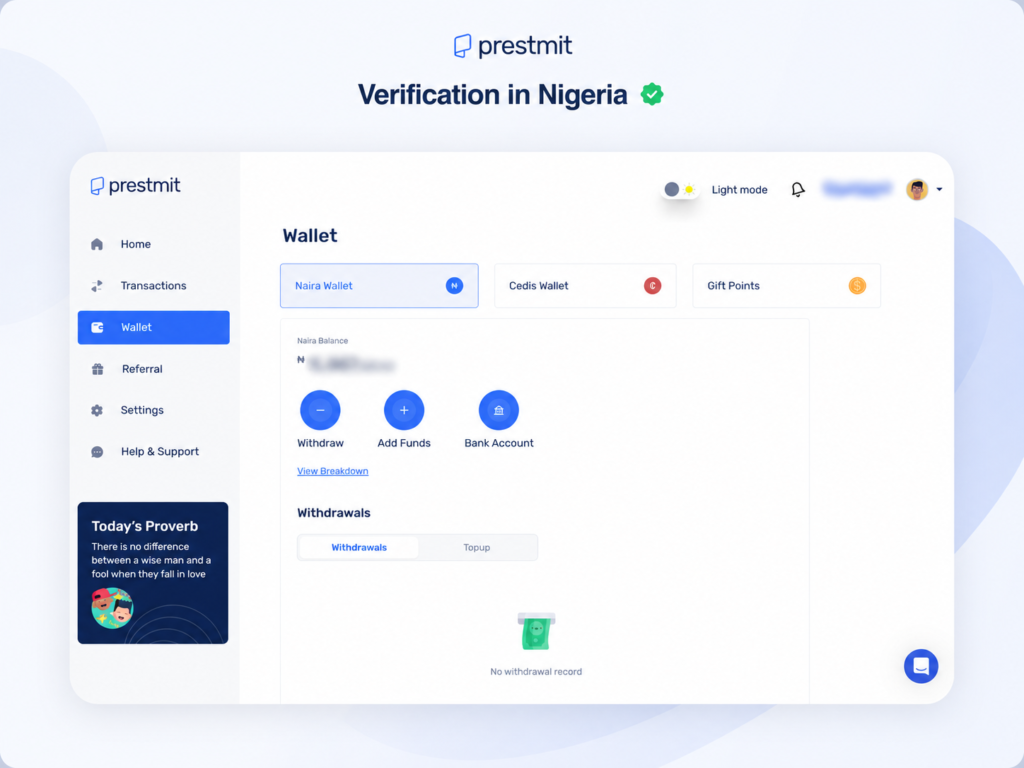
Prestmit was used as a Nigeria verification sample.
Nigeria’s crypto ecosystem is especially important because local users often rely on a mix of exchanges, P2P routes, payment apps, gift card conversion services, mobile wallets, and off-ramp tools.
The Prestmit sample helped demonstrate how Nimbus approaches platforms that may not behave like traditional full-service exchanges.
Nimbus reviewed:
This type of verification is important because Nigeria’s crypto infrastructure often sits across the boundary between exchange, payment, conversion, and off-ramp behaviour.
A platform may support crypto flows, but the user journey may not look like a traditional exchange deposit-and-withdrawal cycle.
For compliance and investigation teams, that difference matters.
It affects how funds move, where on-chain visibility begins and ends, and what evidence is needed to understand the platform’s role in the local ecosystem.
Thailand was mapped as a market with a more regulated exchange layer but a broader platform landscape around it.
The study reviewed different types of Thailand-facing crypto platforms, including:
The key value in Thailand was not just identifying licensed exchanges.
It was separating the full market into useful operational categories.
That matters because different platform types answer different intelligence questions.
A regulated exchange may be useful for formal VASP mapping. A broker-style platform may reveal retail access routes. A P2P venue may show informal liquidity. A payment-linked platform may show crypto-to-fiat movement. A digital asset platform may be relevant for local investor behaviour but may not support normal crypto withdrawals.
Without classification, the market looks like a flat list.
With classification, it becomes a usable map.
Brazil, Nigeria, and Thailand do not follow the same crypto infrastructure pattern.
Brazil has a more formalised exchange and investment platform ecosystem.
Nigeria has a more fragmented, mobile-first, P2P-heavy, payment-linked market.
Thailand has a stronger regulated exchange layer, with additional broker, wallet, and alternative access routes around it.
A single global exchange dataset cannot capture these differences properly.
Knowing that a platform exists is not enough.
Teams need to know whether the platform is a:
Each category has different implications for fund flow, attribution, compliance, and user behaviour.
Some platform functionality only becomes visible after account creation, KYC, or local access.
Important details are often hidden until the user enters the platform environment.
These include:
This is why field access matters.
A screenshot is useful.
A live transaction is stronger.
The highest-confidence evidence comes from combining:
This makes the attribution evidence auditable and repeatable.
Some platforms support deposits but restrict withdrawals.
Some platforms allow withdrawals only on selected chains.
Some platforms push users into fiat cashout, internal conversion, or local payment routes.
This creates different investigative implications.
If funds enter on-chain but exit off-chain, investigators need more than wallet labels. They need platform behaviour notes.
Platform availability, wallet access, supported assets, chain availability, fees, and withdrawal rules can change over time.
A one-time platform list becomes stale quickly.
Country coverage needs:
This is especially true in fast-moving markets like Brazil, Nigeria, and Thailand.
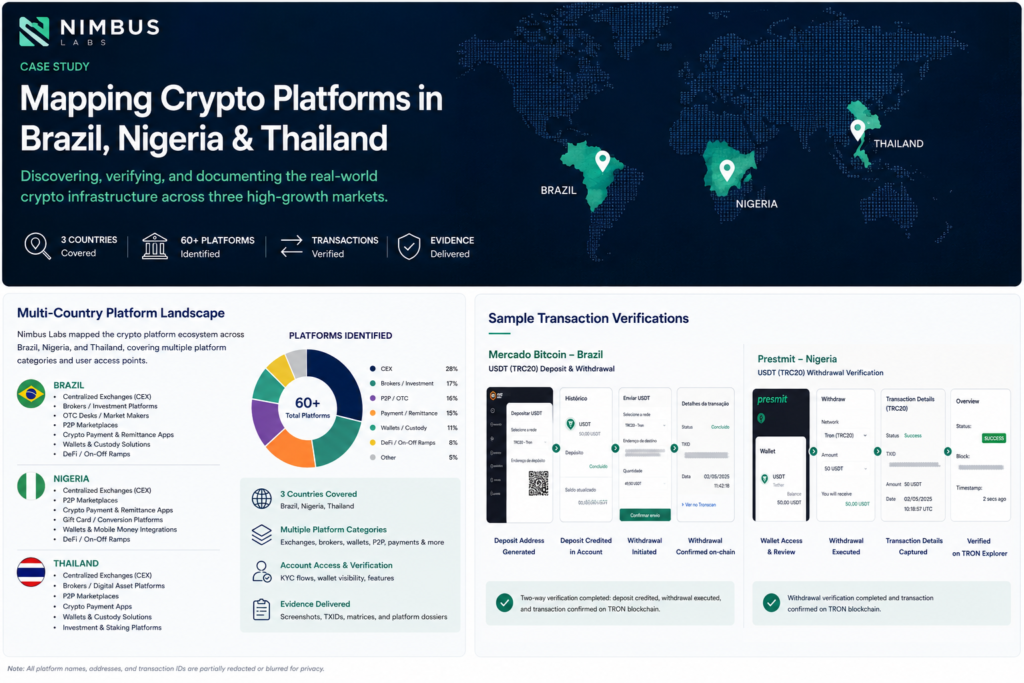
The study produced a structured multi-country evidence bundle.
Deliverables included:
These outputs are designed to support:
This work gives clients a clearer view of local crypto infrastructure in markets where public data is incomplete.
It improves wallet attribution and service labelling by adding local platform context and transaction-backed evidence.
It helps identify relevant VASPs, off-ramps, payment routes, and platform behaviours in specific countries.
It provides screenshots, TXIDs, access notes, and platform-level evidence that can support case work.
It shows how crypto access actually works in each country, not just which brands appear in search results.
It helps distinguish between exchanges, brokers, wallets, payment services, off-ramps, and other platform types.
Crypto infrastructure is local.
The same asset can move through very different rails depending on the country, platform type, user access, KYC status, fiat options, and withdrawal rules.
A global wallet label may tell you where funds touched a service.
It does not tell you how that service works in Brazil, Nigeria, or Thailand.
Nimbus Labs fills that gap.
By combining platform discovery, local access, wallet capture, transaction testing, screenshots, TXIDs, and structured reporting, Nimbus turns fragmented emerging-market crypto infrastructure into usable intelligence.
The result is a more accurate view of:
For teams operating in blockchain intelligence, compliance, investigations, Travel Rule workflows, and emerging-market risk analysis, this gives a stronger foundation than public platform lists alone.
The Brazil, Nigeria, and Thailand study showed that emerging-market crypto infrastructure cannot be understood through surface-level research.
Each country has its own platform mix, access constraints, payment behaviours, and operational quirks.
Nimbus Labs mapped these ecosystems by combining country-level platform discovery with selected live verification.
The result was a structured intelligence layer that helps teams understand not just which platforms exist, but how they actually function.
That is the core Nimbus advantage:
Evidence-backed local crypto infrastructure intelligence, built from the ground up.