
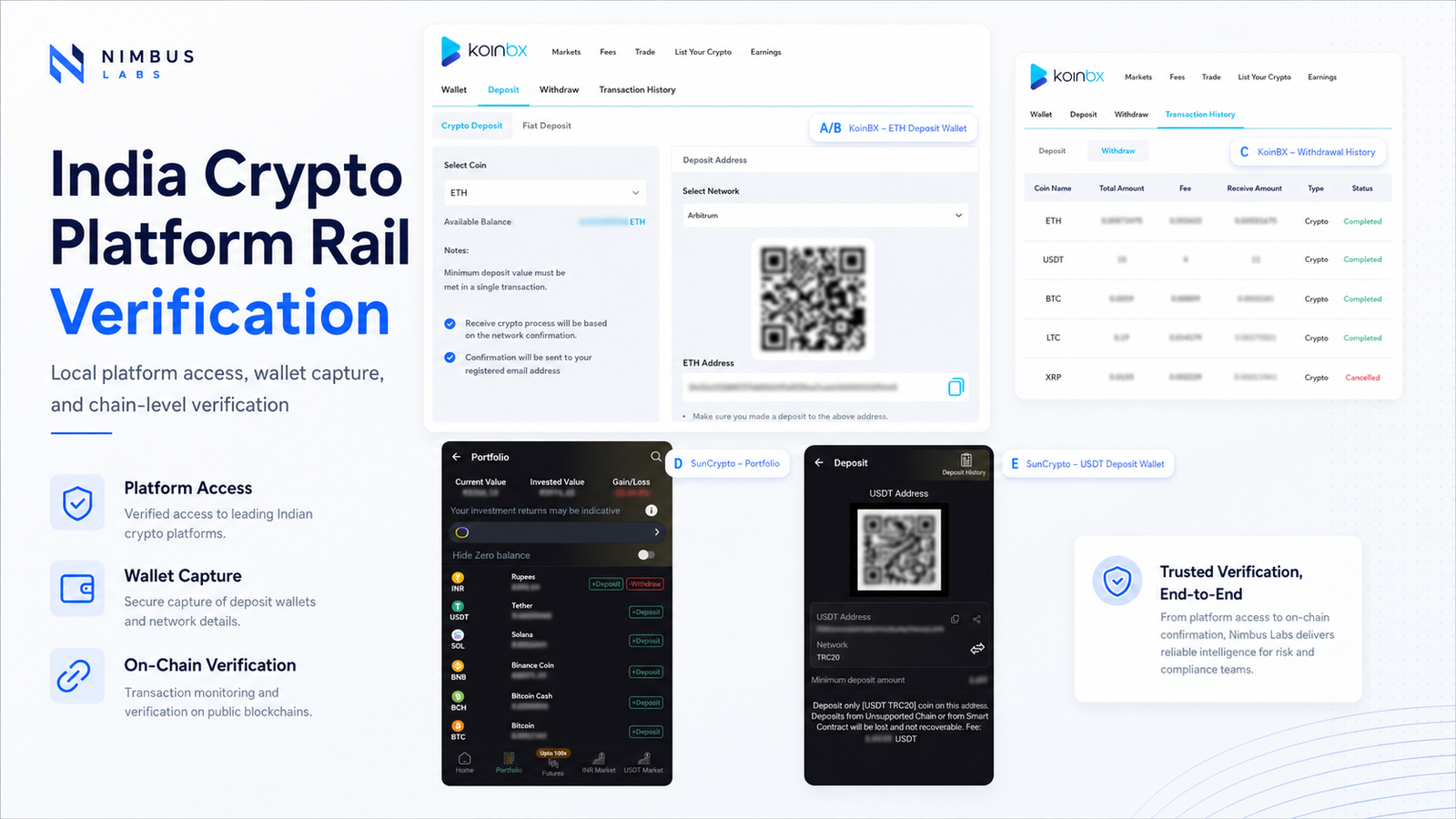
Public exchange lists rarely show how crypto platforms actually function in local markets.
A platform may appear active from the outside, but that does not confirm whether users can:
For blockchain intelligence, compliance, and attribution workflows, those details matter.
Nimbus Labs conducted an India-focused crypto platform verification study to map local and India-accessible crypto infrastructure beyond surface-level exchange labels.
The objective was to verify:
India has one of the world’s most active crypto user bases, but its platform landscape is fragmented.
The market includes:
Each venue has its own rules around:
For analysts relying only on public data, this creates a major blind spot.
A platform may list crypto assets but restrict withdrawals. A deposit wallet may appear inside the interface, but that does not prove the rail is active. A chain may be visible in the UI while still being unavailable, restricted, or subject to specific warnings.
Standard OSINT can identify candidate platforms. It cannot reliably verify live platform behaviour.
Nimbus set out to create an evidence-backed view of India-facing crypto platform infrastructure.
The study focused on five core questions:
The goal was not simply to list exchanges.
The goal was to verify real platform functionality.
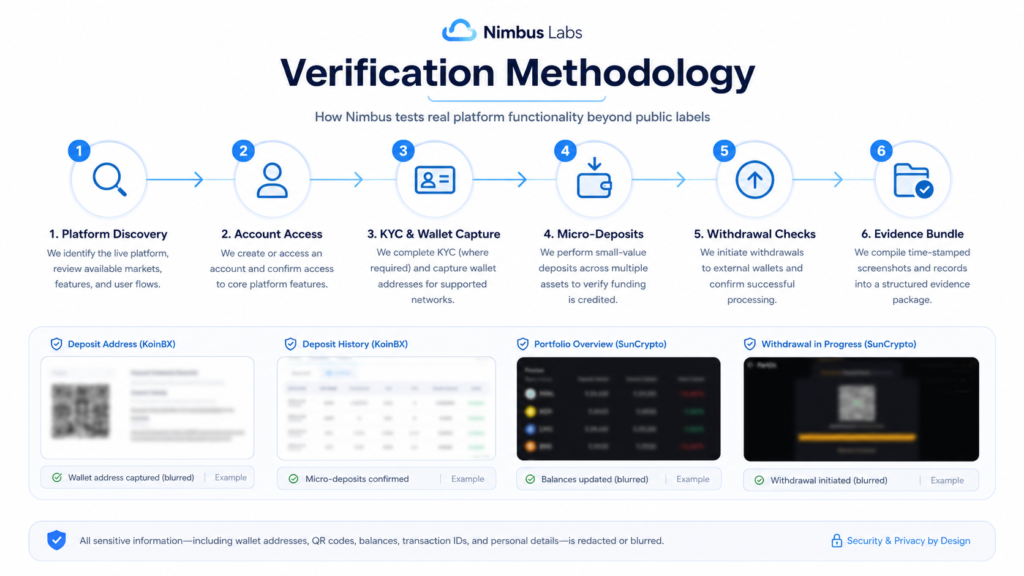
Nimbus used a field-verification model combining local platform research, account access, wallet capture, transaction testing, and structured evidence packaging.
Nimbus identified India-relevant crypto platforms across:
Each platform was reviewed for:
Where feasible, accounts were created or accessed to confirm what users could actually see after registration.
This allowed Nimbus to separate public claims from account-level functionality.
The study reviewed whether platforms required:
Deposit interfaces were reviewed across supported assets and networks.
Nimbus captured:
The work covered major crypto rails including:
Where feasible, small-value deposits were initiated to verify that displayed wallet addresses were operational.
This helped confirm:
This step matters because a visible deposit interface does not automatically prove that the rail is live.
Where platforms allowed crypto withdrawals, outbound transactions were initiated back to control wallets.
This created a stronger evidence trail:
Where withdrawals were restricted or unavailable, that behaviour was documented as an operational constraint.
Findings were organised into analyst-ready outputs, including:
This evidence structure allows compliance, investigations, and attribution teams to understand not just which platforms exist, but how they function in practice.
The study reviewed a broad set of India-facing and India-accessible platforms, including local exchanges, broker-style platforms, and other services relevant to crypto access in the Indian market.
Examples included:
Each platform was assessed across:
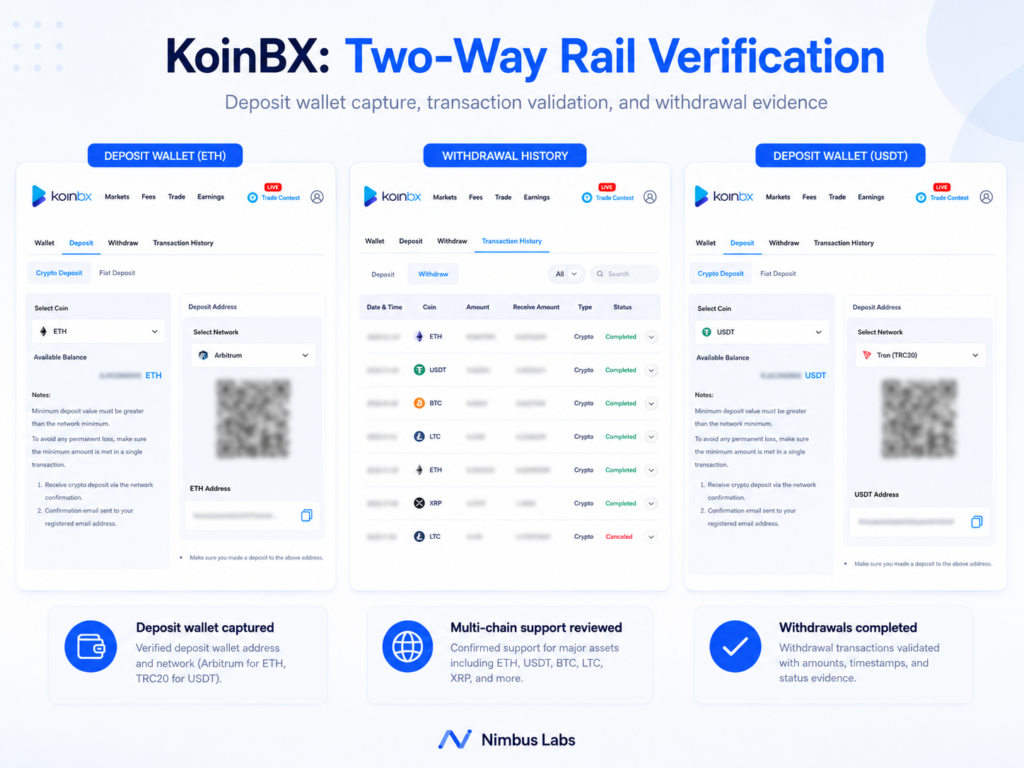
KoinBX provided one of the clearest examples of two-way rail verification.
Nimbus reviewed deposit wallet functionality across supported assets and captured wallet interfaces for assets such as ETH and USDT.
The platform showed network-specific deposit options, including:
Nimbus also reviewed withdrawal history and confirmed completed crypto withdrawals across multiple assets.
The verification path included:
This created a stronger attribution evidence trail than a simple wallet screenshot.
For intelligence workflows, this matters because it validates both the inbound and outbound side of platform activity.
A platform label becomes more useful when backed by:
SunCrypto showed a different but equally important platform pattern.
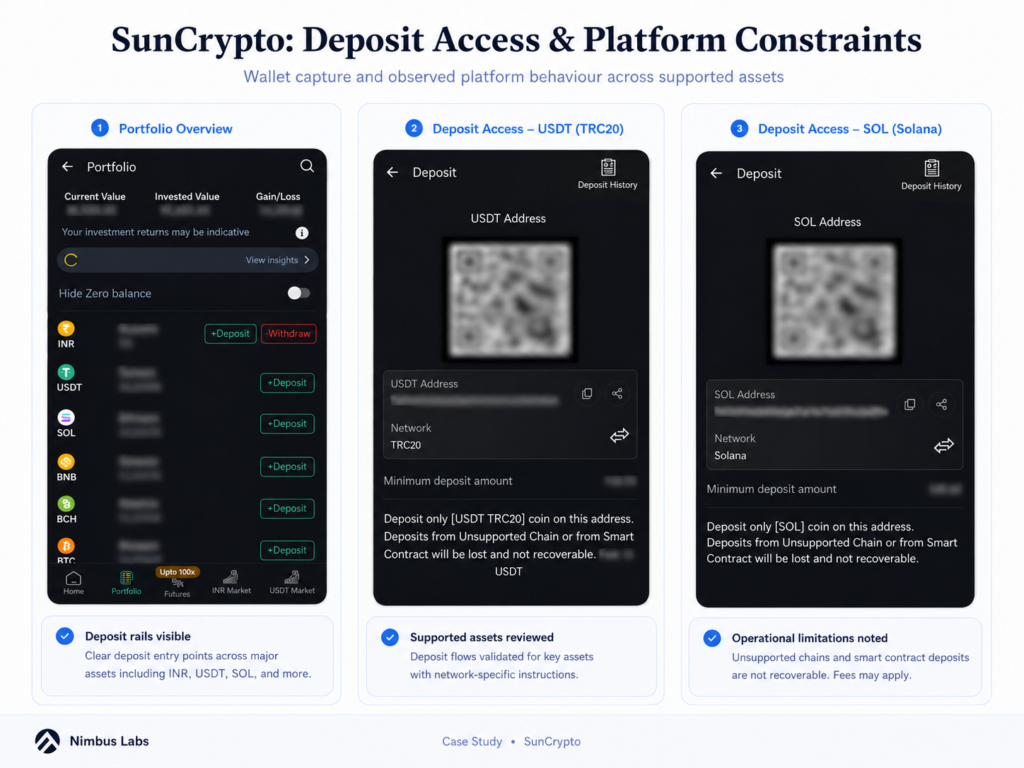
Nimbus reviewed the platform’s mobile wallet interface and captured deposit access across assets such as USDT and SOL.
The app exposed:
This type of evidence is useful because it shows how the platform presents wallet functionality to local users.
Even when a platform supports deposits, the operational model may differ from a full two-way exchange. Some venues may allow deposits while restricting crypto withdrawals, requiring users to exit through INR or internal market flows instead.
For attribution and compliance teams, this distinction matters.
A deposit-only or restricted-withdrawal platform changes how fund movement should be interpreted. On-chain visibility may stop at the platform deposit point, while the user’s exit path may continue through fiat, internal settlement, or off-chain rails.
Exchange directories and public platform pages can identify possible venues, but they do not confirm real user functionality.
Account-level review is needed to verify:
Some platforms expose multiple deposit rails. Others support only selected assets or chains.
Important differences include:
These differences are operationally important for attribution work.
Not every platform that accepts crypto deposits allows crypto withdrawals.
The study observed several platform patterns:
This creates different risk and investigation profiles for each venue.
It is not enough to say a platform supports USDT, ETH, or BTC.
Analysts need to know:
USDT on TRON, ETH on Arbitrum, SOL on Solana, and other chain-specific rails may behave differently from platform to platform.
A wallet label becomes more valuable when supported by:
This is the difference between a static label and operational intelligence.
The study produced a structured view of India’s crypto platform infrastructure, with platform-level and chain-level evidence suitable for blockchain intelligence, compliance, and attribution workflows.
The final evidence model included:
The work demonstrated how local platform verification can strengthen:
Crypto attribution is often treated as a wallet-labelling problem.
In emerging markets, that is too shallow.
The real question is not only:
Which wallet belongs to which service?
The stronger question is:
Which local platforms exist, who can access them, which rails work, what KYC is required, which chains are live, and how do funds actually move through the platform?
Nimbus Labs answers that second question.
By combining local access, wallet capture, micro-transactions, withdrawal testing, screenshots, TXIDs, and structured reporting, Nimbus turns fragmented platform behaviour into usable intelligence.
For teams working across blockchain analytics, compliance, investigations, Travel Rule workflows, VASP discovery, and emerging-market risk mapping, this field-tested approach provides a more reliable view of local crypto infrastructure.
Nimbus Labs maps local crypto infrastructure through:
Contact Nimbus Labs to request a sample coverage bundle or discuss a priority market.