
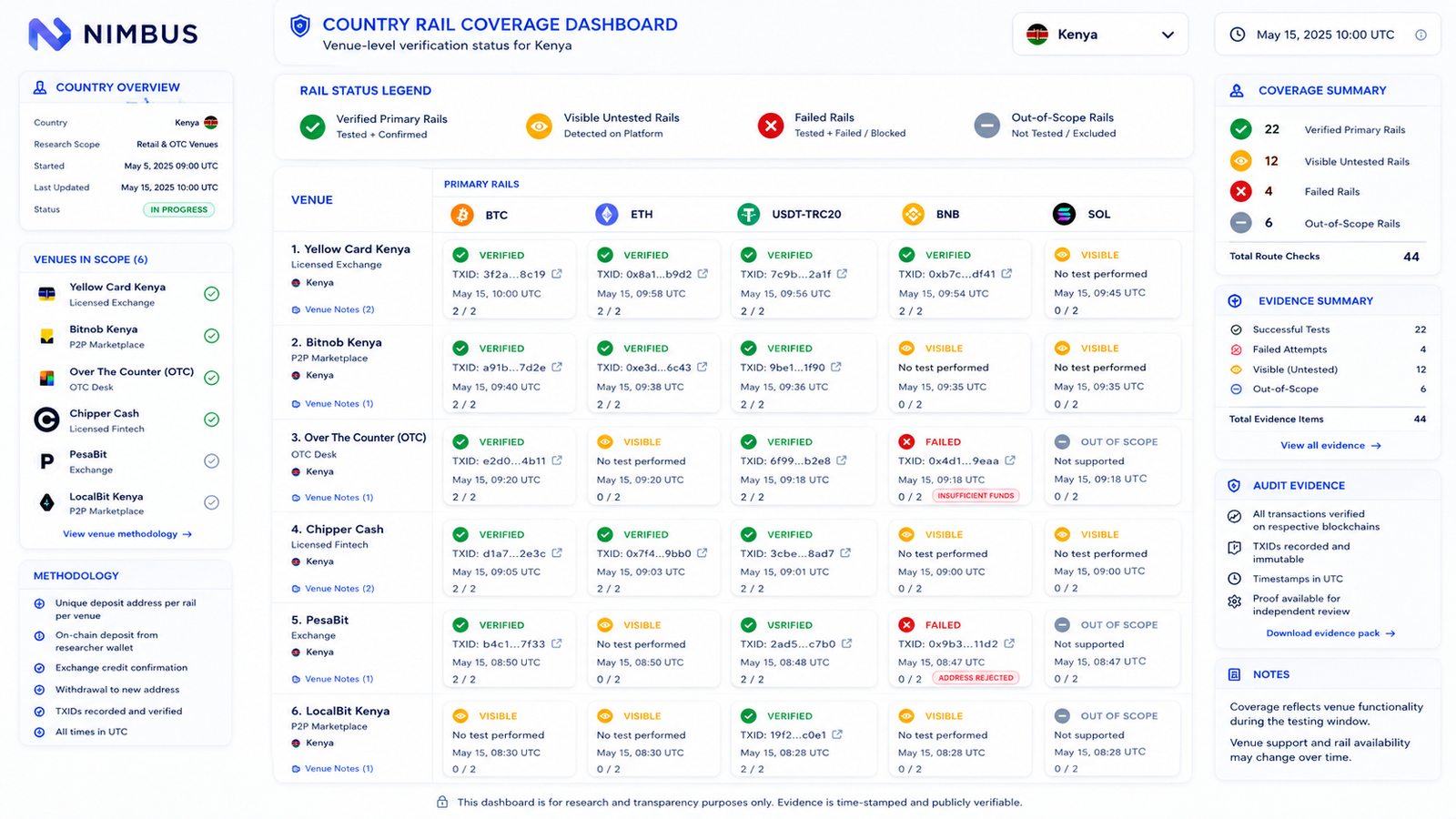
Primary-rail verification is not a full audit of a crypto venue. It is targeted proof that a platform can generate, receive, credit, and sometimes withdraw through the most important transaction rails.
Crypto attribution always involves a trade-off between depth, speed, cost, and coverage.
A full verification cycle across every chain, asset, KYC tier, account type, and withdrawal method can become expensive quickly. Every additional network adds more work: account setup, local access, deposit testing, withdrawal testing, screenshots, transaction fees, network fees, failed attempts, retries, minimum deposits, and sometimes lost funds on deposit-only platforms.
That is why many investigations use a primary-rail model.
Instead of testing every possible asset and network, the researcher focuses on the rails most likely to matter for attribution, off-ramp mapping, and investigative utility.
These usually include:
Primary-rail verification does not prove everything. But when done properly, it proves something valuable: that a venue is operationally reachable through specific live rails, under specific account conditions, at a specific point in time.
That is far stronger than a public claim, old label, or scraped directory.
A platform appearing in a public directory does not prove it is operational.
A website may still load even if trading is dead. An app may exist even if deposits are disabled. A support page may list chains that no longer work. A platform may claim country availability but block users during KYC. An exchange may show crypto balances but prevent withdrawals. A local broker may advertise USDT support but fail to provide a usable address.
Primary-rail verification tests whether the venue actually works.
At a basic level, it shows whether a real account can access the platform, whether the platform can generate a deposit address, whether a selected asset and chain are visible, whether a micro-deposit can be sent, and whether the balance is credited after confirmation.
That moves the record from:
“This venue exists.”
To:
“This venue was operationally verified on this rail.”
For attribution work, that difference matters.
Wallet attribution decays because venues rotate addresses, change custody providers, update infrastructure, disable chains, or migrate users to new wallets.
A primary-rail test creates fresh evidence. It can show the current deposit address displayed to a verified account, the asset and chain linked to that address, the account context in which it appeared, and whether funds were actually credited after a test deposit.
This is the core value.
A blockchain label without recent verification is only historical intelligence. It may still be useful for older investigations, but it should not be treated as proof of current infrastructure.
Primary-rail verification refreshes the attribution layer.
It answers a simple but important question:
Can we prove this venue still exposes this rail today?
A deposit address is useful, but it is not enough by itself.
The verification record should also explain the conditions under which that address became visible. This includes the country of access, account type, KYC tier, documents required, local phone or bank requirements, resident or non-resident status, and whether the rail appeared before or after verification.
This matters because crypto venues do not expose the same infrastructure to every user.
A rail may be available only after email verification, phone verification, basic KYC, enhanced KYC, proof of address, local ID verification, business account approval, domestic bank linking, or manual risk review.
Without access-condition metadata, the attribution is weaker.
A deposit address alone says:
“This rail exists.”
A stronger record says:
“This rail exists for this type of user, in this country, at this verification level, on this date.”
That is much more useful for investigators, compliance teams, and analytics vendors.
Deposit address generation is useful. But a generated address does not prove that the rail works.
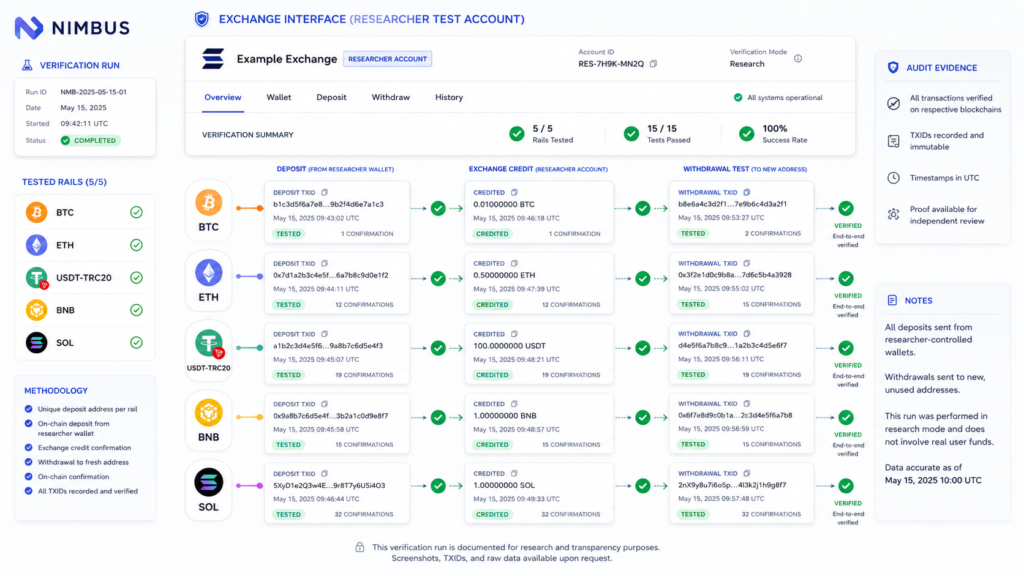
A stronger test proves the platform can actually receive funds. That means the platform generated a valid address, a micro-deposit was sent, the transaction confirmed on-chain, and the platform credited the user balance.
This turns a static address into an evidence-backed attribution point.
It also separates real rails from interface noise. Some platforms show deposit options that fail when used. Some generate addresses but do not credit funds. Some support a chain technically but have broken monitoring. Some require minimum deposits, and anything below the threshold may not appear in the account.
Primary-rail deposit testing exposes these problems.
This is why “deposit address observed” and “deposit credited” should be treated as different evidence levels.
This is where precision matters.
Primary-rail verification does not automatically prove two-way functionality unless withdrawal testing is included.
There are three different levels of evidence:
These are not the same.
A platform may support deposits but not withdrawals. It may support withdrawals only after higher KYC. It may support crypto deposits but fiat-only withdrawals. It may auto-convert crypto into local balance. It may impose minimum withdrawal limits that make testing expensive. It may also hold withdrawals for manual review.
So the wording matters.
A primary-rail test should say “deposit rail verified” when only the deposit was tested. It should say “withdrawal visible but not tested” when the interface shows a withdrawal option but no outbound transaction was performed. It should say “withdrawal verified” only when funds were successfully withdrawn and an outbound TXID was captured.
It should not say “full rail verified” unless both deposit and withdrawal were tested.
That protects the dataset from overclaiming.
Not every chain has equal investigative value.
A venue may technically support dozens of assets. But most investigation and off-ramp work focuses on the rails that carry meaningful liquidity.
Primary rails are selected because they tend to be high-volume, widely supported, common in exchange deposits, useful for tracing major flows, relevant to stablecoin cash-out, and cost-effective to test.
USDT on TRON often matters because it is cheap, fast, and widely used in P2P and broker activity. BTC and ETH matter because they remain foundational rails. BNB and SOL may matter depending on regional exchange behaviour and user demand.
Primary-rail verification proves that the venue has live access on the rails most likely to matter.
It does not prove the venue has no other rails.
It proves that the selected rails were tested and observed.
That distinction is important.
Primary-rail verification is not the same as full-depth mapping.
It does not prove every supported chain, every supported token, every deposit method, every withdrawal method, every fiat payout option, every KYC tier, every regional account variation, every business feature, or every temporary edge case.
A venue may support additional networks that were not tested. These could include Polygon, Avalanche, TON, XRP, XLM, DOGE, Litecoin, BCH, Arbitrum, Optimism, Base, or local stablecoin rails.
If those networks were outside the test scope, the report should say so clearly.
A good primary-rail report should separate:
This keeps the output honest.
It also helps clients understand the difference between tested proof and broader coverage claims.
Primary-rail verification is timestamped evidence.
It proves what was true during the test window. It does not prove that the same rail will remain active forever.
A venue can later rotate deposit addresses, suspend a chain, change custody providers, increase KYC requirements, disable withdrawals, remove a token, change minimum deposits, block a country, replace payment processors, introduce Travel Rule checks, or move to new wallet infrastructure.
This is why every record needs freshness metadata.
The stronger claim is not:
“This venue supports USDT-TRC20.”
The stronger claim is:
“USDT-TRC20 deposit was verified for this venue under these account conditions on this date.”
That is a cleaner intelligence statement.
It gives the reader both the finding and the limits of the finding.
Primary-rail verification is infrastructure evidence. It is not a full risk assessment.
It does not automatically prove that a platform is compliant, non-compliant, high-risk, safe, licensed, exposed to suspicious flows, or knowingly serving illicit actors.
It proves access, rails, and transaction behaviour under tested conditions.
Risk interpretation requires additional evidence. That may include regulatory status, licensing records, transaction exposure, known illicit counterparties, sanctions screening, scam reports, dark-market links, P2P merchant behaviour, Telegram group links, or internal compliance posture if available.
Primary-rail verification is one layer.
It should feed into risk analysis, not replace it.
A venue can be known without any route being verified.
A platform may appear in a regulator’s list. It may be mentioned in media. It may have a public website. It may have an app. It may claim to support crypto. It may appear in older datasets.
None of that proves current rails.
Primary-rail verification creates a different category: a verified route.
A verified route connects a specific platform, asset, chain, account type, access tier, test date, evidence set, and transaction result.
That is more valuable than entity discovery alone.
For Nimbus-style outputs, this distinction should be explicit. A discovered entity has been identified as relevant, but not yet tested. An accessible entity has confirmed account access. A deposit-verified entity has generated and credited a tested deposit. A withdrawal-verified entity has produced an outbound transaction. A fiat-observed entity has visible local payout methods, even if those were not tested.
This avoids confusion between coverage and proof.
Attribution confidence depends on evidence quality.
Weak confidence may come from public claims, user reports, old screenshots, third-party lists, unverified wallet labels, historical address clusters, or interface-only observations.
Stronger confidence comes from live account access, fresh deposit address generation, successful micro-deposits, confirmed crediting, outbound withdrawal TXIDs, timestamped screenshots, KYC-tier documentation, repeated observations, and consistency with known wallet infrastructure.
Primary-rail verification improves confidence because it creates direct evidence.
It links the platform interface to the blockchain transaction.
That link is the attribution bridge.
Full-depth verification is useful, but it is not always necessary for every market, every platform, or every client need.
Primary-rail verification gives a practical middle path.
It is especially useful when the goal is to confirm whether a venue is operational, refresh stale attribution, verify the most important rails, map priority exchanges in a market, identify deposit-enabled services, test stablecoin cash-out relevance, build a country-level intelligence baseline, or decide which venues deserve deeper investigation.
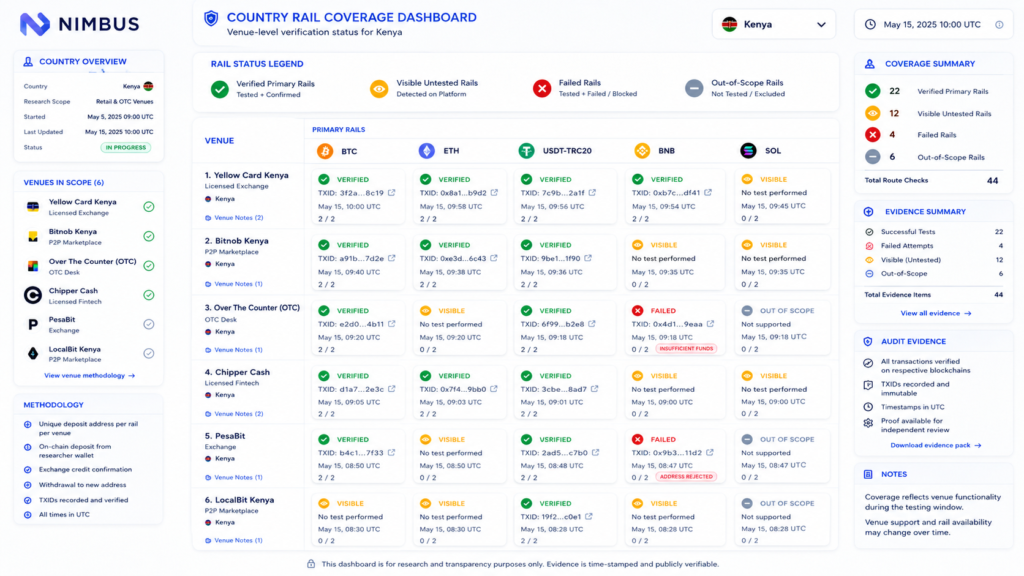
This makes it a strong first-pass model for country mapping.
A client may not need every altcoin rail verified immediately. They may first need to know which venues are active, which primary rails work, and which platforms deserve deeper follow-up.
Primary-rail verification provides that first layer of proof without pretending to be exhaustive.
A clean verification record should include enough detail for another analyst to understand exactly what was proven.
It should identify the venue, domain or app, country context, and entity type. It should explain the account context, including account country, user type, KYC tier, verification requirements, and access limitations.
It should also record the asset and network tested, whether the test involved deposit, withdrawal, or both, and any relevant minimum deposit, withdrawal, or fee constraints.
The evidence layer matters most. A strong record should include deposit address screenshots, TXIDs, credited balance screenshots, withdrawal screenshots where relevant, outbound TXIDs where tested, and clear timestamps.
The result should be written plainly. Was the address generated? Was the deposit sent? Was it credited? Was withdrawal visible? Was withdrawal completed? Was the rail blocked, failed, or out of scope?
Analyst notes should capture the messy parts: KYC constraints, broken flows, manual review, deposit-only behaviour, auto-conversion, local payment observations, and suggested re-test window.
This is what makes the dataset auditable.
Primary-rail verification proves that a specific venue, under specific account and jurisdictional conditions, exposed or processed specific high-value crypto rails during a specific test window, with evidence linking the platform interface to on-chain activity.
That is the clean claim.
Not more. Not less.
It does not prove total platform coverage. It does not prove permanent support. It does not prove every chain. It does not prove every user type. It does not prove platform-wide risk by itself.
But it does prove something far stronger than a scraped list or inherited label.
It proves live operational access on the rails that matter most.
Crypto investigations fail when they rely on stale or shallow labels.
A wallet may have been correctly attributed years ago but no longer represent active infrastructure. A platform may be listed in public directories but no longer credit deposits. A venue may support USDT on paper but not in a tested local account. A deposit address may exist, but withdrawals may be blocked. A cash-out path may require higher KYC.
Primary-rail verification reduces that uncertainty.
It helps investigators understand whether a platform is active, which major rails are live, whether funds can be credited, whether withdrawals are visible or tested, what KYC tier is required, what country access conditions apply, and whether the attribution is current.
For wallet attribution, country mapping, exchange intelligence, off-ramp discovery, VASP discovery, Travel Rule enrichment, dataset refreshes, and investigation triage, that is a useful proof layer.
The point is not to claim exhaustive knowledge.
The point is to replace assumptions with tested evidence.
Primary-rail verification does exactly that.